
These days much of my research concerns the first residents at the Moreton Bay penal settlement in addition to the work devoted to extending my own family’s origins. As many of these original settlers have become favourites, one of my endeavours has been to create unique descriptions of their Moreton Bay years encouraging them to tell their own stories by exploring primary records and placing these characters at sites familiar to them and among fellow inhabitants.
This technique is easily adapted to retelling specific experiences of family forebears and could incorporate domestic residences, school skills, sporting and or hobby involvement, employment and extend to favourite teachers, particular friends, social occasions or other momentous life events. Bring your rellies to life and let them speak for themselves.
Introducing Lewis Lazarus
One of the 1824 initial convicts sent with Commandant Henry Miller and Surveyor General John Oxley to establish the new depot at Redcliffe was Lewis Lazarus, a 14-year-old born in Hull who was transported to Sydney for life on the Isabella in 1818 after facing trial at the Old Bailey for stealing John Mason’s watch and chain and key valued at 24 pounds 12 shillings. The 4feet 10inch (147cm) teenager claimed tailoring experience but over the next five years, his aberrant behaviour earned him time at Newcastle, Port Macquarie and Emu Plains before, as a prisoner in Sydney Gaol, he was selected for the new northern gaol. Believe it or not, a second Lewis Lazarus joined him at the Brisbane River site in October 1825 so careful distinction was necessary. Using settlement documentation as a guide, Lewis Lazarus now recounts some of his early impressions. All authority figures were unceremoniously lumped together as ‘they’.
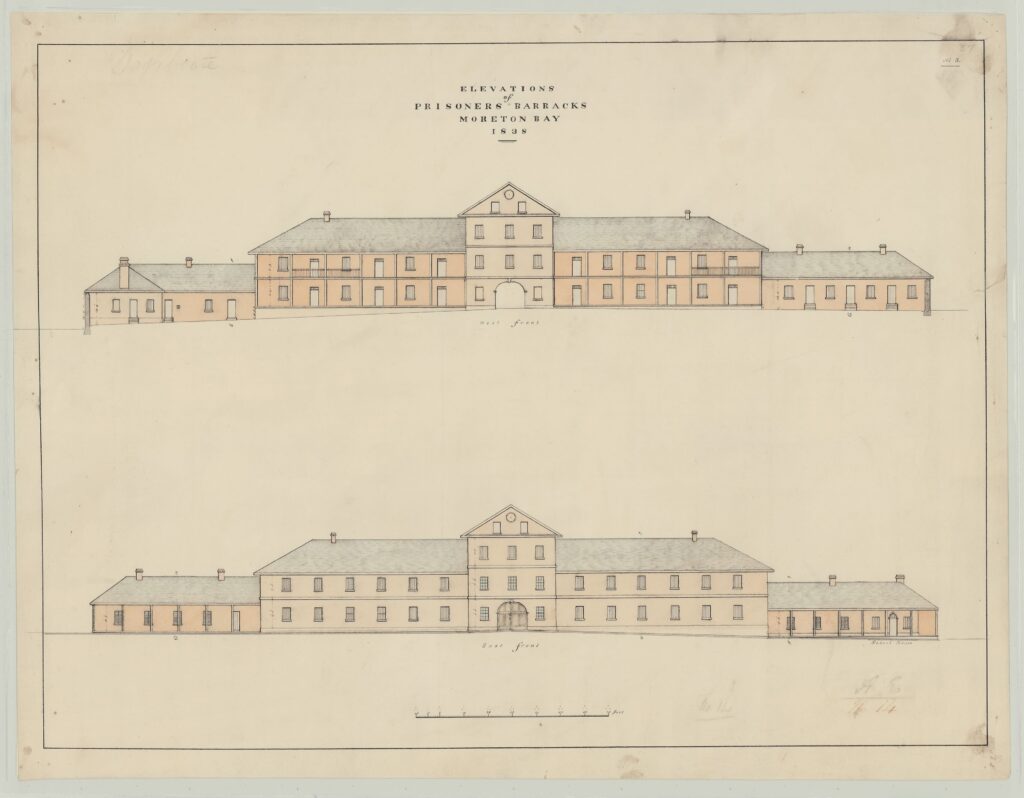
Prisoner Barracks
“When we first moved to Brisbane Town from Redcliffe, we would have given anything for barracks like the new ones recently built on the main street because we were crammed into tents and primitive slab huts (near the corner of present-day Queen and Albert Streets). Few of the men had construction skills so temporary buildings were used until other more urgently needed stone buildings were erected as skilled experienced builders arrived. Although we were meant to sleep in hammocks or on straw palliasses on the floor, they soon did away with these because not only did the numbers increase by the hundreds, but this type of bedding harboured lice and rats from the river and also it was known some convicts hid items snitched from fellow prisoners among the straw. On hot nights we were better on the flat boards.
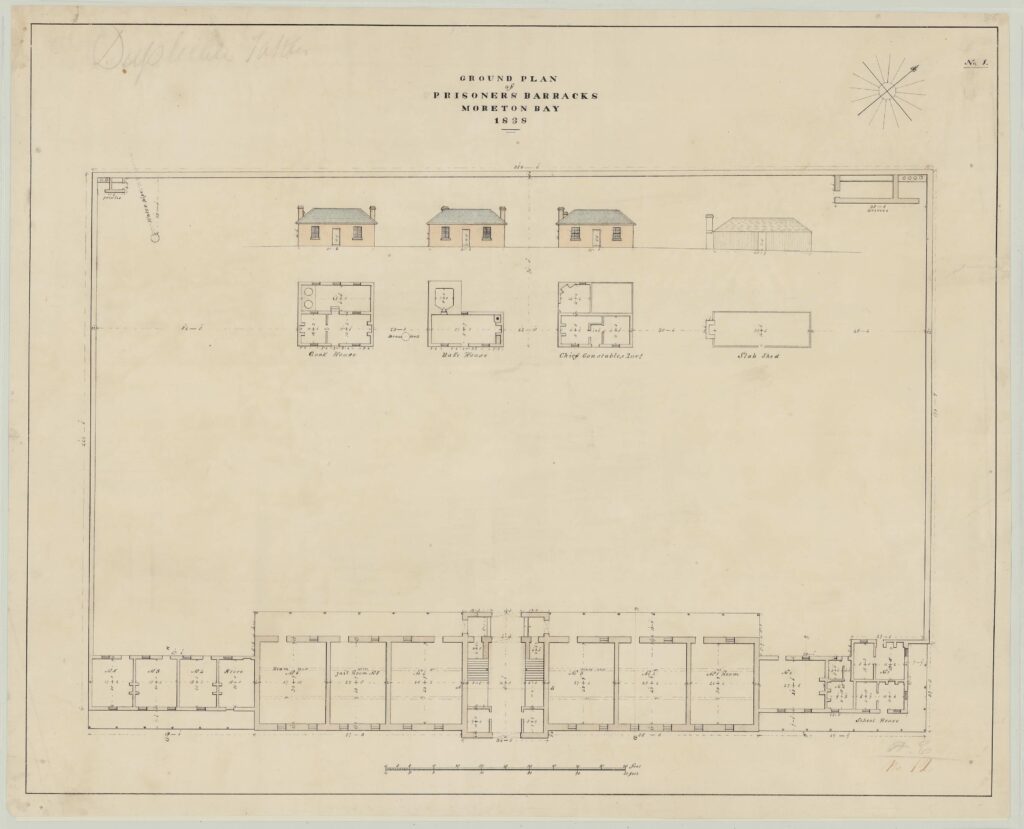
They held church services upstairs on Sundays but we few Jewish prisoners were not compelled to attend; nor were we permitted to read our own services. For the few Hebrews, there was no chance of having our own sacred day off work, so Saturdays were just like weekdays. The increasingly large number of Roman Catholics were allowed to pray together. On the whole most Protestant convicts attended services as part of a quiet day but only a few of the older ones paid heed to any talk of redemption. The daily routine was too onerous and unrelenting for many of us to believe in salvation.
Our cook house, plastered and shingled with a brick chimney, was close by and until I escaped for a few months in January 1826, I worked as assistant cook and helped collect wood and water, then after I was sent back, as an assistant in the hospital. All these buildings, erected when we had just over 100 prisoners on site, quickly became far too small because within five years the settlement had grown to over 1000 prisoners. The possibility of working at one of the out-stations at Eagle Farm, Cowper’s Plains, Limestone or Dunwich was one way to avoid living with hundreds of people but then the quietness and loneliness was overwhelming and sometimes frightening but I gradually became familiar with bush noises and fauna although friction sometimes occurred with the local Indigenous people. Is it any wonder that men wanted to escape?”
Military Barracks:
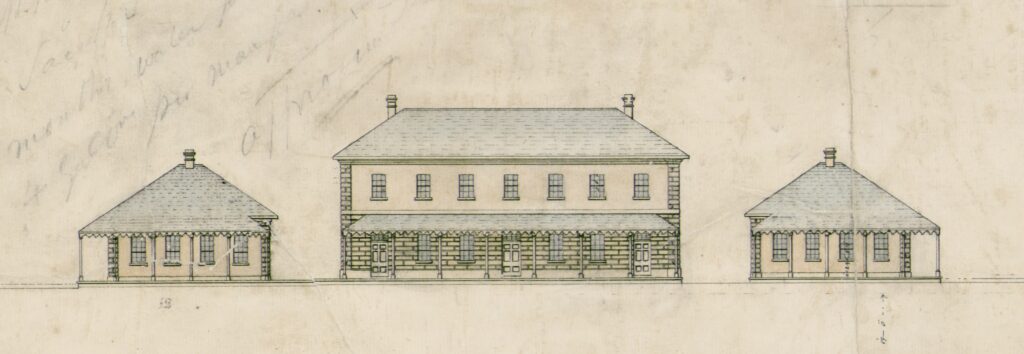
“Even though the military are here to guard and control us, ensuring that quarrels are settled quickly and without violence, some of the soldiers struck up friendships with us. I always found Commandant Logan’s military servant, Private William Collison, a good man. He accompanied Captain Logan on his exploring trips having been with him in 1829 when they explored along the Brisbane River to the Mount Esk district. Again, in October 1830 when the 57th Regiment was in the process of returning to Sydney for posting to India, Collison went with his master to the Brisbane valley to trace river windings and to explore more of the Stanley River. On the return trip to Ipswich, after directing his group to establish camp on Esk Creek, the Captain became separated from his party and was chased and killed by natives. Over the following days, Collison and another private soldier, James Hardacre, searched widely for him eventually finding his saddle before returning to Limestone. From here the alarm was raised and a party of 5 soldiers and 12 prisoners were rallied supplemented by more men from Brisbane under Dr Cowper’s leadership. Because of my knowledge of the terrain, I was one of these together with my mate, Guiseppe La Barbiera. With the doctor, Collison and Hardacre, we found part of the Captain’s blood-soaked waistcoat and the following day we finally came across his deteriorating body with his head badly beaten by waddies. Mrs McCauley, Matron of the Female Factory and her boy George saw our boats return to Brisbane when Captain Logan’s body, wrapped in stringy bark, was taken to the hospital. Dr Murray prescribed an opium dose for the distressed widow and Mary McCauley, Mrs Letitia Logan’s old friend and comforter, accompanied the family back to Sydney for the Captain’s funeral. Soon afterwards the bereaved family returned to Ireland. My dismal and painful duty was rewarded with Captain Clunie eventually supporting my return to Sydney in February 1832 although the military had immediately sent Collison back to headquarters for the funeral and Hardacre was back there by the end of 1830.”
These two ‘first person’ examples, based on established sites, one indicating living conditions and the other a very significant settlement event, have been extracted from Old Bailey records, shipping indents, gaol registers, Colonial Secretary’s correspondence, the Biographical Database of Australia, George McCauley’s reminiscences (NLA) and newspaper reports, each fact supported by precise references. In these days before photography, building plans have been used here for illustrative purposes but maps, likenesses, plans, coin reproductions or even school reports or floor plans might be included. How do your family members tell their stories?
Leave a Reply