
On a recent European cruise, we stopped at Zeebrugge, and the ship offered an excursion to Ypres, Belgium, the site of three First World War battles. My husband and I booked the visit as I have a person in my family history, Andrew Petrie Porter, who remains missing after the Third Battle of Ypres, Belgium. I often research and write about Andy as he was known, as he is one of the favourites from my family history.
The first battle of Ypres occurred between October and November 1914, followed by the second battle in April and May 1915. The third battle, however, involved many Australians from all the five Australian Divisions and was also known as Passchendaele. Australia had over 38,000 casualties here, including 10,000 deaths.[1] This battle was known for the ever-present lousy weather, mud, shattered buildings, homes, farms, and sometimes whole villages.

On the excursion, we arrived in Ypres after a long bus ride from the ship. Our local guide first took us to Tyne Cot Cemetery, the largest cemetery managed by the Commonwealth War Graves Commission (CWGC), and I noticed several gardeners busy at work in the graveyard.
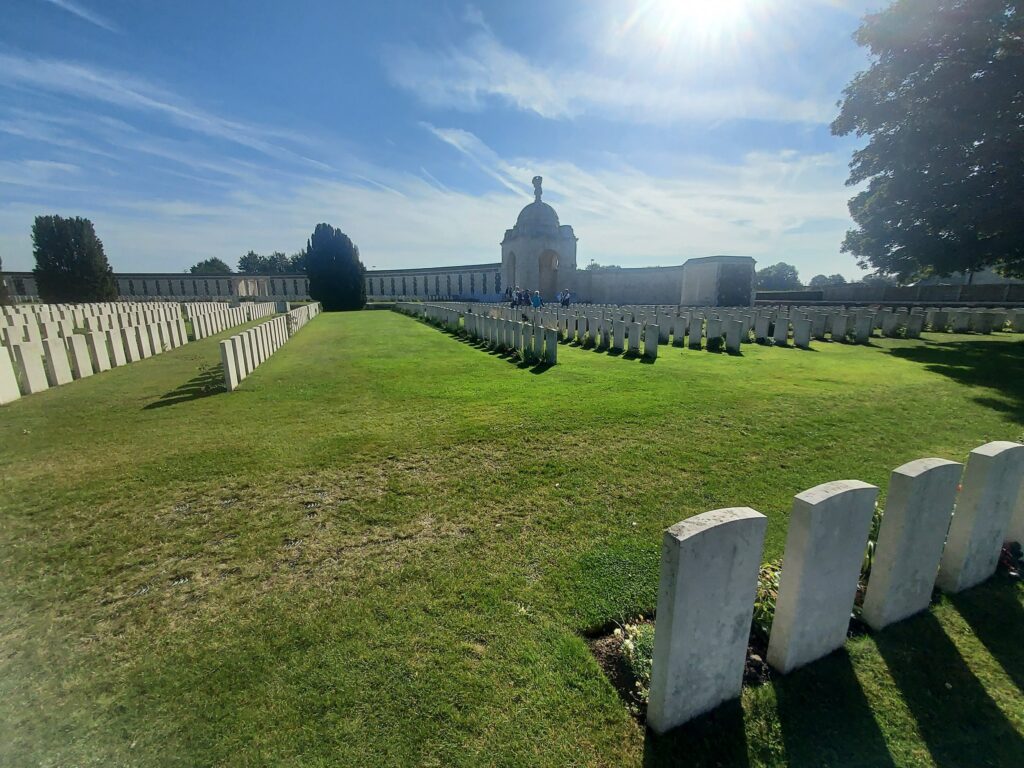
Australian historian Matthew Haultain-Gall talks about the tortured Belgian earth from which bodies were retrieved after the First World War and reburied in nearby cemeteries managed by CWGC or its predecessor.[2] The British, Australian, Canadian, New Zealand, South African and Indian governments fund the CWGC to maintain the graves of those of the Allies who fell during wars. The Tyne Cot Cemetery also has a few German graves.
What was so poignant at Tyne Cot was the row upon row of unknown soldiers intermingled with some identified deceased soldiers. Reading “An Australian Soldier of the Great War” was common. Alternatively, a British or New Zealand soldier. Worse was the inscription “A Soldier of the Great War”. No name and no nationality, only the inscription “Known only to God”.
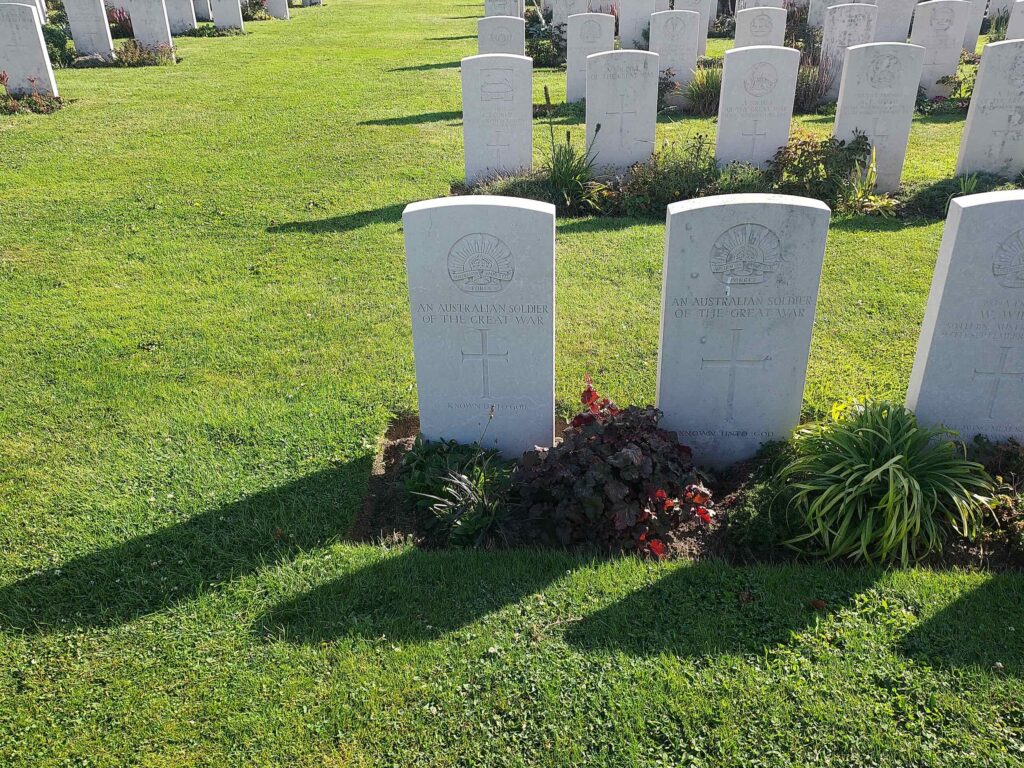
British school children visit Tyne Cot as part of their studies. They are known to visit the graves of teenage soldiers, and unfortunately, I cannot remember the name of the young soldier’s grave. The children must find visiting these graves harrowing. Our tour found it moving, and we were adults.
After Tyne Cot, we visited the Essex Farm Cemetery, another CWGC cemetery. Our guide said that soldiers of one of the Essex regiments camped here, and later, the Cemetery and adjacent Advanced Dressing Station were renamed Essex Farm. The dressing station bunker, used for immediate medical aid for the injured, was renovated in the 1990s. For those who did not survive, the cemetery was nearby, facilitating the movement of the dead.
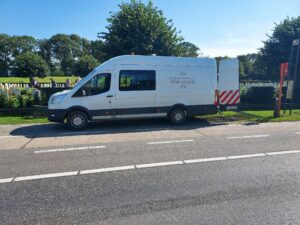
Like the Tyne Cot Cemetery, the CWGC impeccably maintained the Essex Farm Cemetery. The reason for this was the presence of several gardeners with their nearby van, which belonged to the Commonwealth War Graves Commission. Here is the evidence of the CWGC funding at work.
This cemetery has 1,206 graves, of which 106 are unidentified. Our local guide told us this site was where Canadian Major John McCrae’s poem “In Flanders Fields” originated. McCrae, a surgeon, wrote the poem in 1915 during the 2nd battle for Ypres. McRae wrote the poem after a friend, a fellow Canadian, Lieutenant Alexis Helmes of Ottawa, died of wounds on 2 November 1915.[3] McCrae wrote the elegy and then purportedly threw it away, but fortunately, a colleague retrieved it, and the poem remains one of the most poignant and memorable poems of the Great War. The poem is displayed near the remains of the dressing station, and they form a part of the memorial to the dead of the Ypres Salient over a century ago. The poem reflects on the vision of poppies growing between the numerous graves in Flanders.

After lunch, we reunited with our guide and walked across the town to the Menin Gate. I wanted to see the Menin Gate and Andrew Petrie Porter’s name in person, inscribed amongst the 54,000 names of the missing soldiers with no known grave. The aim of my excursion was not to be.
The Menin Gate was being refurbished and was under cladding and scaffolding and will not reopen until 2025. I was devastated. I had broken the genealogist’s rule of checking the opening hours of places you are travelling to visit. However, I had visited Ypres and would have gone even if I knew that the Menin Gates was undergoing refurbishment. I was on this cruise, and having the Ypres excursion was an extra benefit. I had seen the cemeteries and the dressing station and visited Ypres.
I saw the names of some British and Canadians missing at the Menin Gate, but not any Australians and particularly not Andy’s name. In speaking to us, the guide shared his knowledge of Great War poet Lieutenant Siegfried Sassoon. Sassoon was an officer who had won a Military Cross earlier, and his men respected him. At Ypres, Sassoon was invalided to a British hospital and eventually diagnosed as suffering from Neurasthenia (or Shell Shock). Today would probably be diagnosed as having Post-Traumatic Stress Disorder (PTSD).
In July 1917, Sassoon wrote his Commanding Officer. “I am Finished with War: A Soldier’s Declaration.” He was wilfully declining to return to his military duty. He was a caring officer who worried about his men and the mounting number of dead and injured. Later, in 1918, he wrote a poem, “Memorial Tablet,” which included the following lines: ‘I died in hell. They called it Passchendaele’. Andrew Petrie Porter suffered through this when he went missing, as reported in October. An inquiry into Andy’s status found he was killed in action on 9 October 1917. Andy also died in hell.[4]
Under draconian British military law, the authorities could have charged Sassoon with cowardice and shot him, but the British authorities showed mercy. It would have been bad press for an officer and Military Cross recipient if Sassoonn was charged. Sassoon did eventually recover and return to the front, but he was another casualty of the Great War, although he had survived physically.

My excursion to Ypres was emotionally challenging, but I am pleased I visited. Our guide was passionate about what happened in his local area, Ypres, long before he was born, and he shared that passion with his visitors. While I have previously written about Andrew Petrie Porter in the past, I will continue to do so but with increased awareness of Ypres. I will never forget that Andy died “in hell”. My dear wish is that one day, Andy’s remains will be identified, and he will be buried with military honours in the companionship of his fellow victims of Passchendaele.
[1] Matthew Haultian-Gall, The Battlefield of Impreshiiable Memory: Passchendaele and the Anzac Legend, Monash University Publishing, Cayton, Victoria, 2021, p. 2.
[2] Ibid.
[3] https://en.wikipedia.org/wiki/In_Flanders_Fiellds, accessed 27 October 2024.
[4] National Archives of Australia, First World War Personal Dossiers, Porter, Andrew Petrie, B244, 80183448, https://recordsearch.naa.gov.au/, accessed 28 October 2024.